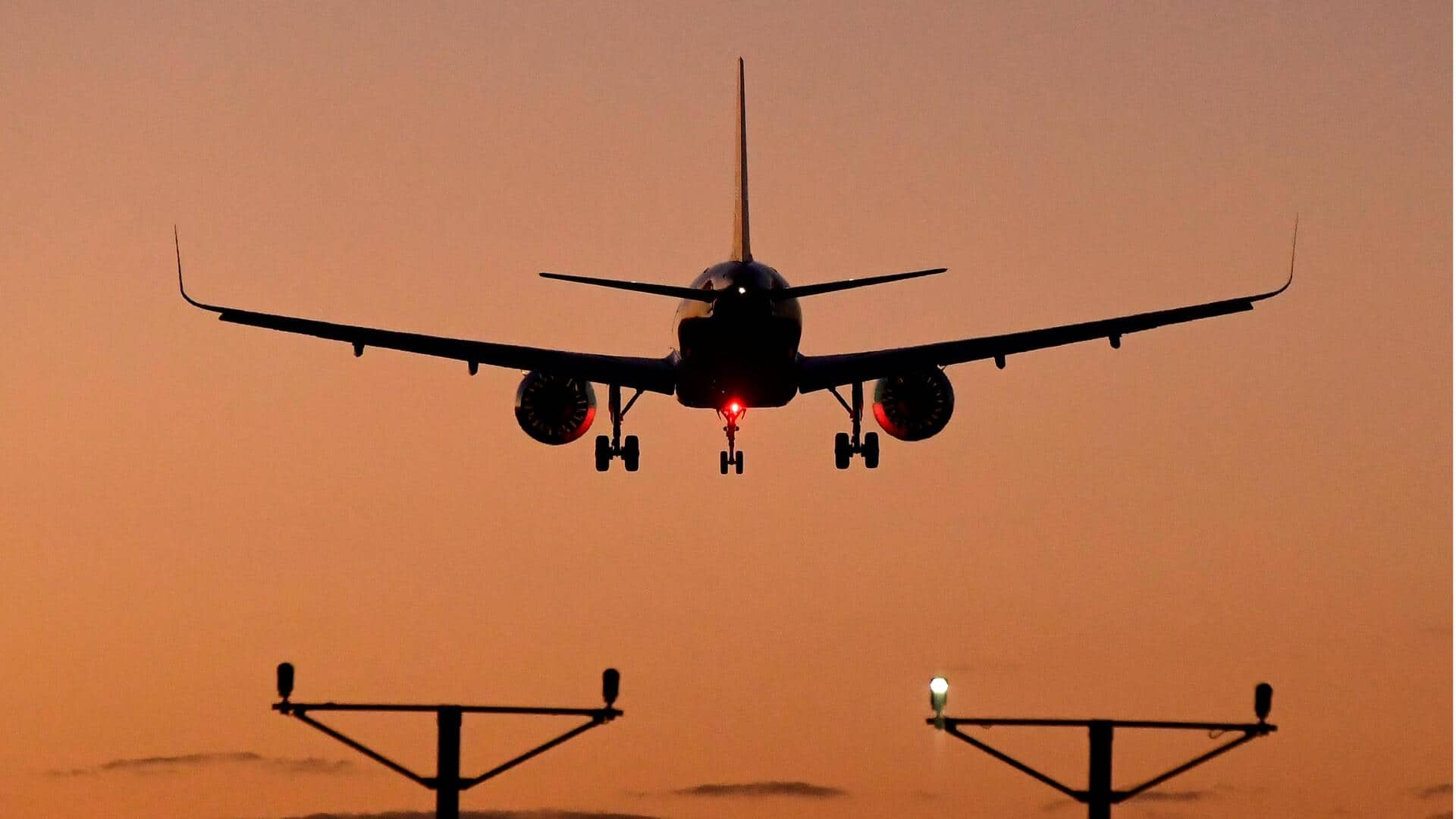
Why air travel might be harmful to your health
What's the story
A recent study has revealed that airline passengers are exposed to high levels of ultrafine particle pollution. The research, conducted by a team of French scientists from Universite Paris Cite, involved flying a pack of instruments with passengers on flights from Paris Charles de Gaulle to various European destinations. The equipment was placed on an empty seat in the front rows or in the galley area.
Health risks
Ultrafine particles: Invisible threat to health
Ultrafine particles are invisible and often go undetected by traditional monitoring methods. As a result, they fall outside the purview of air pollution regulations.
In 2021, the Dutch Health Council and WHO highlighted the growing evidence that ultrafine particles are damaging to health, based on 75 studies related to lung inflammation, blood pressure, heart problems, and risks to fetal growth.
However, technical differences between these studies prevented WHO from establishing a standard.
Mortality risk
Long-term exposure linked to early deaths
A study involving nearly 11 million people in the Netherlands found that long-term exposure to ultrafine particles was associated with early deaths, including from lung cancer.
The new research found high levels of ultrafine particles during specific phases of air travel.
It found that ultrafine particle pollution levels were low when planes were cruising at high altitudes but spiked during boarding and taxiing on the ground.
Exceeding limits
Pollution levels exceed WHO's high threshold
The study found that the ultrafine particle pollution levels during boarding and taxiing were more than twice those considered high by WHO, although WHO has not set a specific standard for ultrafine particles.
The contaminated air was gradually removed from the cabin after takeoff but increased again on landing approach, possibly due to high concentrations near flight paths and downwind from airports.
This pattern was also observed at destination airports.
Worrying
Aircraft are still polluting with little regulation
The study saw that black carbon or soot particles were at their highest when the plane was at an airport.
This is a major concern as global air passenger numbers are projected to exceed five billion this year for the first time.
Aircraft are still relatively polluting with little regulation compared to road traffic and industry.
Community impact
Ultrafine particles spread beyond airport boundaries
The study said that ultrafine particles from Charles de Gaulle Airport not only affect people at the airport but also spread to neighboring communities.
The concentration of these particles 1km away from the airport was similar to those near Paris's busy ring road.
At London Gatwick, ultrafine particle levels 500 meters away from the perimeter fence were higher than those next to central London's busiest roads.