Vanished Andromeda star leaves behind strange red glow: What's happening?
What's the story
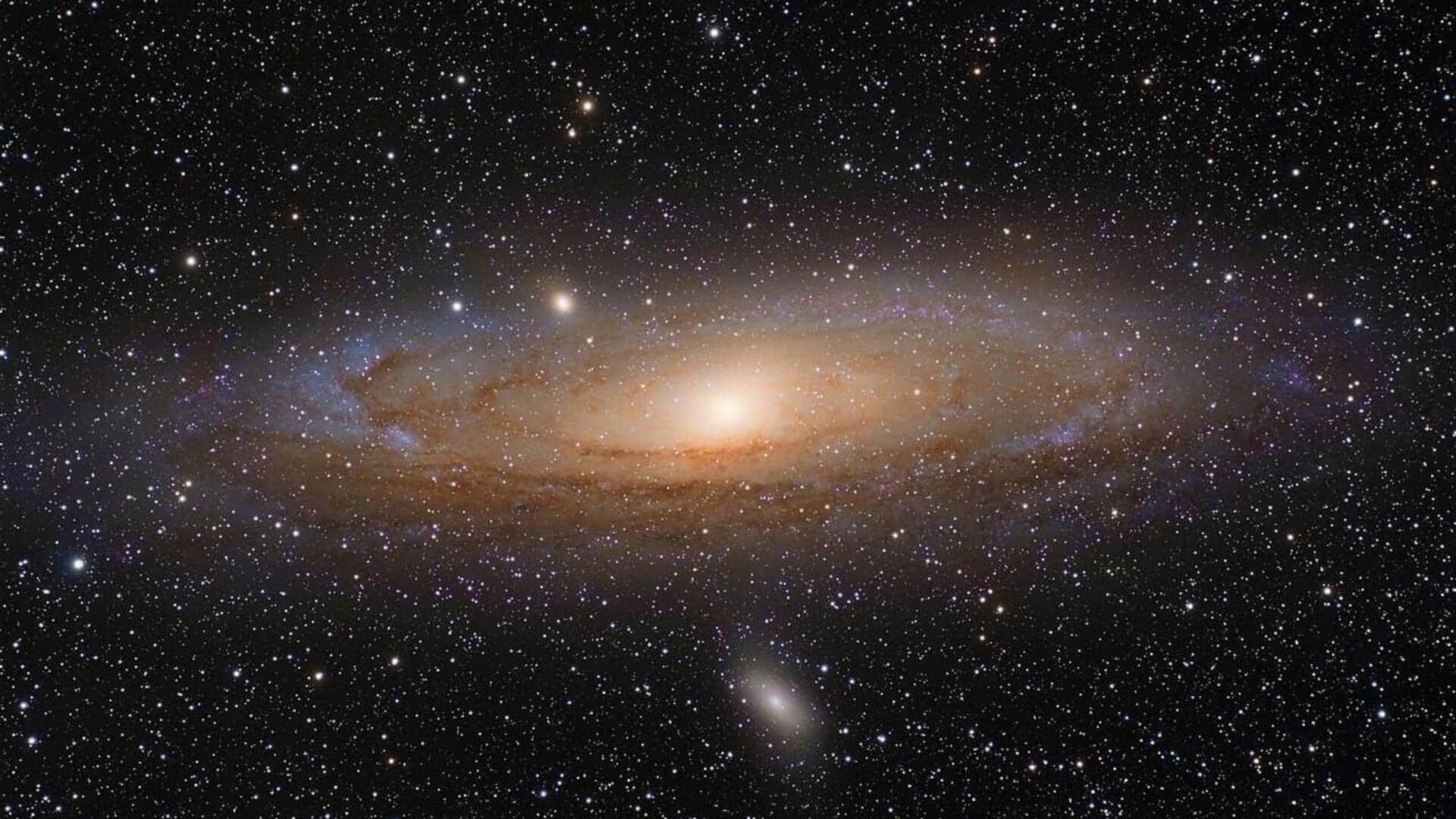
Astronomers are puzzled by the disappearance of a yellow supergiant star, M31-2014-DS1, in the Andromeda galaxy. The star was last seen shining brightly between 2014 and 2018. Its sudden disappearance has left scientists scratching their heads, as there were no signs of a supernova explosion that usually marks such stellar events. Two research teams have since proposed possible explanations for this cosmic mystery.
Stellar transformation
Black hole formation without supernova: A possible explanation
One of the research teams, using data from the James Webb Space Telescope (JWST), has suggested that M31-2014-DS1 might have collapsed into a black hole without exploding as a supernova.
They proposed this scenario in their preprint paper, yet to be peer-reviewed.
The researchers noted that "stellar-mass black holes (BHs) are understood to represent the end states of massive stellar evolution."
Cosmic remnant
Extremely red source discovered in place of the star
The team used JWST and the Chandra X-ray Observatory to study the remnants of M31-2014-DS1.
They found an "extremely red source" where the star once was, with a brightness only about 7-8% of its original luminosity.
A shell of dust surrounding this red source extends up to a staggering 40-200 times the distance between Earth and Sun.
The researchers believe this could be material ejected by M31-2014-DS1 that's now falling back into a newly formed black hole.
Accretion doubts
Failed supernova theory faces scrutiny
The failed supernova theory has been questioned due to the lack of X-ray observations showing accretion onto a black hole.
If M31-2014-DS1 went directly from being a star to a black hole without a supernova, then luminosity from fallback accretion must decrease as the accretion rate decreases.
However, not much decline in brightness has been observed in this case.
Collision theory
Stellar merger hypothesis emerges
The second research team has proposed that the red source could be a remnant of a stellar merger.
They speculate that two stars may have collided, creating this dust and obscuring the view of what really happened to M31-2014-DS1.
The researchers think that once this dust clears, the main source might become visible, shedding more light on this cosmic mystery.