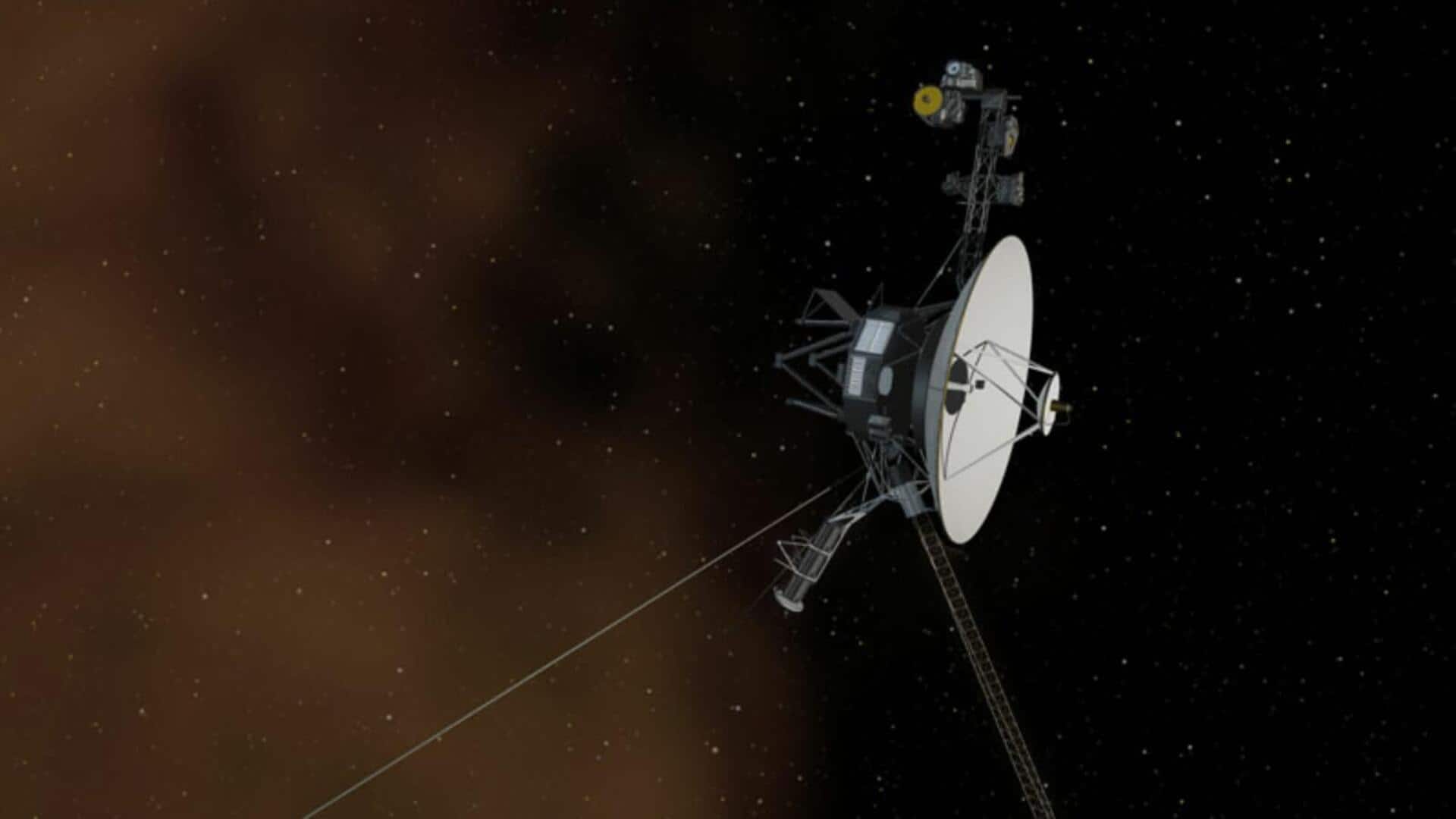
First-in-history: Voyager 1 will be 1 light-day away in 2026
What's the story
NASA's Voyager 1, the farthest human-made object from Earth, is set to reach a historic milestone in November 2026. The spacecraft will be one light-day away from our planet, marking an unprecedented distance for any man-made object. A light-day is the distance traveled by light in one day, which is about 26 billion kilometers.
Distance dilemma
Voyager 1's journey and communication challenges
Voyager 1 was launched in 1977 to explore Jupiter and Saturn, and it has been traveling at a constant speed of 61,155km per hour since its Saturn flyby in November 1980.
The distance between Earth and Voyager 1 means that any signal sent from our planet takes a day to reach the spacecraft.
This means if commands are sent after the probe reaches one light-day away, its response will take another day.
Space pioneers
Voyager probes: Pioneers of interstellar exploration
Voyager 1 and its twin, Voyager 2, are the only spacecraft to have crossed the heliosphere, a protective bubble of magnetic fields and particles created by the Sun.
Both probes have had to turn off some instruments due to distance from Earth.
However, they continue to use their remaining tools to study this unexplored territory and provide data for future missions.
Cosmic communication
Communication over cosmic distances
Voyager 1's trajectory after its Saturn flyby took it up and out of the plane of the planets.
This has made it possible for engineers to calculate how long a signal takes to reach the probe.
However, communicating with such distant probes is not easy. The probes send data at a very low rate of 160 bits per second, similar to dial-up internet speed on Earth.
Probe autonomy
Voyager probes' autonomy and future operations
Despite the low data rate, the Voyager probes are designed to be self-sufficient with plenty of onboard autonomy.
This way, they can save themselves if things go wrong billions of kilometers from Earth.
The team has been making tough decisions over the years to keep the probes operational for as long as possible, by turning off engineering systems and instruments to conserve power.